“Will this sell next week?”
Last month’s sales don’t tell the whole story. Seasonality, local occasions and planned offers can change what customers pick up next.
Turn sales history into smarter demand, inventory and promotion decisions with machine learning. Built for Indian retailers, with a vision to make planning as natural as a conversation.
Compare three offers on an everyday essential.
The 10% offer leaves the most contribution, even though the 20% offer sells more.
An illustrative plan for the week ahead.
Planned demand with a 10% offer
Planning range: 640–920 packsA range helps you plan for uncertainty, instead of treating one number as a promise.
Stock, incoming deliveries and demand together.
Simplified example, before safety stock, case packs and lead-time checks.
Review the stock gap before you commit to the promotion. Every recommendation stays yours to approve.
Example: regular price ₹200, unit cost ₹136, and 500 packs without an offer. Assumed volumes: 780 at 10% off, 960 at 15% off, 1,120 at 20% off. Contribution = sales less product cost, before campaign costs and taxes. Volumes and planning ranges are invented for illustration; this is not a model prediction.
Understand demand
Plan your stock
Make promotions count
You know your customers. You know your shelves. But when demand, stock and offers move together, experience deserves a little more evidence.
Last month’s sales don’t tell the whole story. Seasonality, local occasions and planned offers can change what customers pick up next.
Too little means an empty shelf. Too much means cash tied up in stock. The right order needs more than a look at what’s left.
A busy checkout can hide a shrinking margin. More sales only tell half the story when discounts, costs and other products are involved.
Machine learning forecasts demand and estimates promotion response. Our planning tools connect those estimates with stock, costs and budgets, so your next offer and purchase order work from the same picture.
Compare discounts, bundles and buy-more offers before you commit. See the trade-off between volume, revenue and contribution, with stock and budget in view.
Plan scenarios · Compare outcomes · Review recommendationsA smaller discount can leave more behind.
ML models use sales history, seasonal patterns and planned promotions to forecast demand. See a range of possible outcomes, with the uncertainty made visible.
Daily or weekly forecasts · Product and store levelTurn demand into replenishment suggestions. Bring together stock on hand, incoming deliveries, supplier lead times, case packs, shelf life and your purchase budget.
Replenishment drafts · Stock risk · Budget constraintsLook beyond the sales spike. Compare observed sales with an estimated no-offer baseline, and explore shifts to other products and dips after the promotion.
Promotion hindsight · Product spillovers · Post-offer effectsDid demand grow, move from another product, or simply arrive a week early?
These are model estimates. Real-world impact needs retailer-specific validation.
Bring sales, catalogue and inventory sources together through supported integrations. Trace related records and feed validated data into analytics and shop-specific models: the foundation for contextual AI.
See how it connects“What should I reorder?” “Which offer protects my margin?” “Why did demand change?”
Our vision is to make sophisticated retail planning as approachable as a conversation. We’re bringing together connected business data, predictive machine learning and a planned LLM assistant to help you explore the answer.
Meet the intelligence behind itExplore an example conversation
What should I order before the weekend offer?
In this example, planned demand is 780 packs. You have 420 on hand and 120 arriving before the offer, leaving a 240-pack gap.
Review safety stock, case packs and supplier lead time before deciding what to order.
Your next step: review a replenishment draft.
Which offer leaves me with the healthiest margin?
In this example, 10% off leaves ₹34,320 in contribution. A 20% discount brings more sales, but leaves only ₹26,880.
The 10% offer retains ₹7,440 more contribution. Check campaign costs and stock before choosing.
Your next step: compare the promotion scenarios.
How much demand should I plan for next week?
This example assumes 780 packs with a 10% offer, and a planning range of 640–920 packs.
Review the forecast alongside recent sales, seasonal patterns and local occasions. A range helps you consider uncertainty before committing stock.
Your next step: review demand and its assumptions.
Why could higher sales still leave me less money?
Moving from 10% to 20% off in this example raises sales by ₹38,800, but reduces contribution by ₹7,440.
More volume doesn’t cover the deeper discount here. Connecting sales, offer terms and product costs helps explain the difference.
Your next step: inspect the numbers behind the change.
Scripted concept preview, not a live AI assistant. Figures are illustrative; contribution is before campaign costs and taxes.
Demand and promotion models learn from sales history. Planning tools compare offers and replenishment options against costs, stock and budget.
Bring business records and their relationships together. Trace the evidence behind an insight across sales, products, inventory and supported sources.
Our planned assistant will help retailers ask questions, understand model outputs and explore draft plans in plain language, with the underlying evidence in view.
Our design direction pairs specialised ML with carefully selected, cost-efficient language models. We aim to balance answer quality, response time and running costs, so useful AI can reach the neighbourhood store as well as the larger retail team.
Grounded in your data.Start with the data you have. Build confidence in one focused pilot. Keep the retailer in control of every decision.
Map your sales, products and stock. Check data quality before it powers a plan.
Forecast demand, compare offers and review suggested orders against your constraints.
Approve the plan, follow the results and use the next cycle to make a more informed choice.
Built with small, medium and larger Indian retailers in mind.
Start with a scope that fits your business.
For kiranas, independent grocers and local supermarkets. Bring structure to everyday decisions, from replenishing essentials to deciding whether that weekend offer makes sense.
Tell us about your storeFor supermarkets and growing retail businesses managing broader assortments or multiple sources of sales. Bring your teams’ demand, promotion and stock decisions closer together.
Discuss your businessFor larger teams exploring more rigorous retail planning. Begin with a scoped pilot, agreed data contracts and business-specific validation before a broader rollout.
Explore a scoped pilot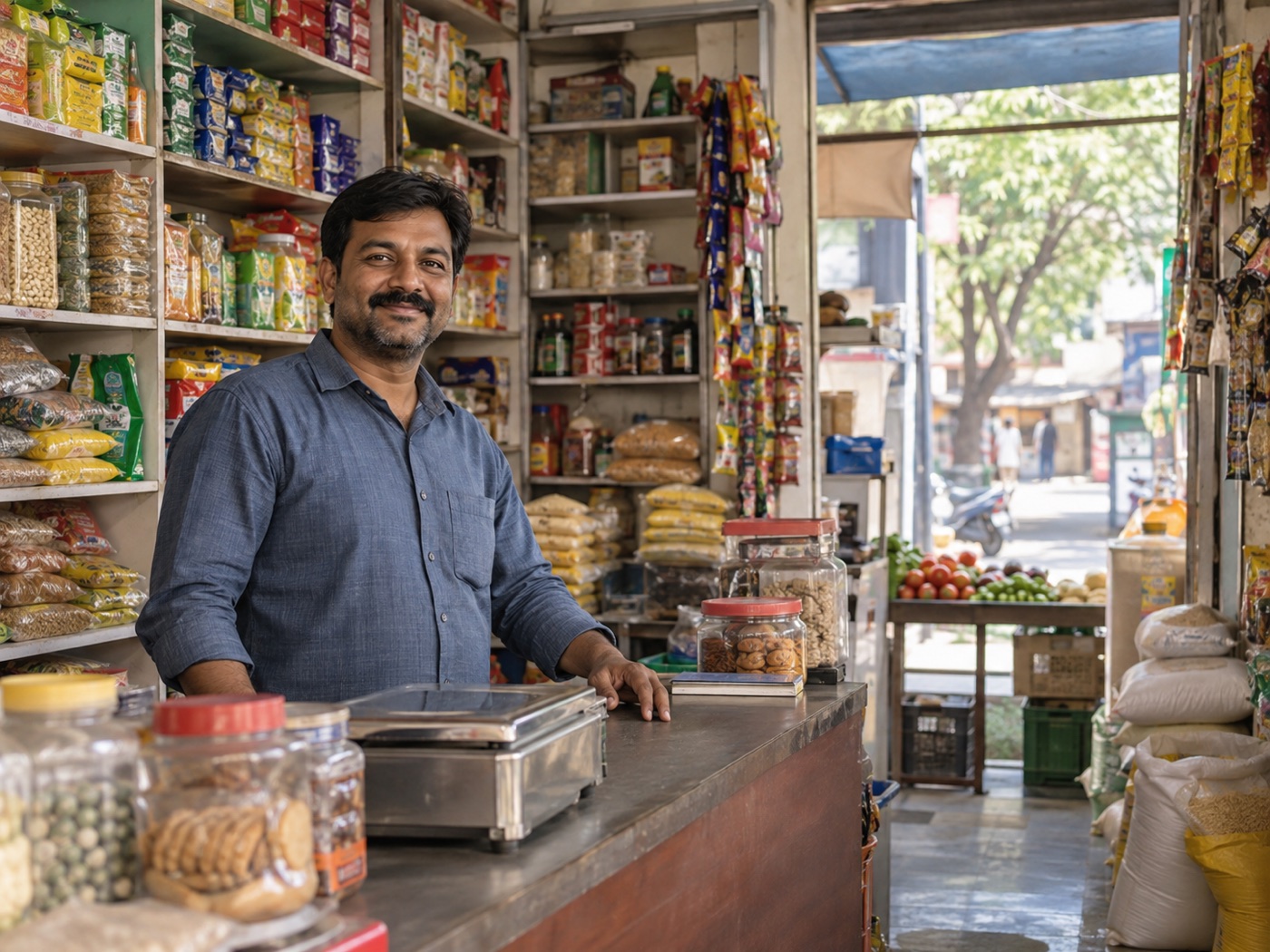
AisleMint began with a simple observation: too many important retail decisions still depend on a guess. What to order. What will sell. Which discount might work.
We’re building an AI-powered retail planning company for India: machine learning for better forecasts, connected intelligence for business context, and a vision for LLM-assisted conversations that make it easier to act on both.
INR planning and GST-aware OneSales checkout workflows.
Plan around local occasions and promotions, with effects validated against your own history.
Understand the evidence. Explore the options. Approve the decisions that affect your business.
Have a different question?
Ask Akash directly.
AisleMint is an AI-powered retail planning startup with a working MVP covering ML forecasting, promotion recommendations, inventory planning, connected intelligence and OneSales checkout. A broader conversational planning assistant is on our roadmap. We’re inviting Indian retailers for demos and scoped pilots, with retailer-specific validation and deployment assessment as part of onboarding.
Our existing ML models estimate demand, no-promotion baselines and promotion response. Forecasting and optimisation tools turn those estimates into scenarios and draft recommendations. Connected intelligence links business records and evidence. Our roadmap adds an LLM assistant to explain results and help retailers explore plans in plain language.
The full conversational planning experience shown here is a concept on our roadmap. Connected intelligence currently provides evidence search and an optional local language-model integration; that integration requires separate setup and evaluation. No cloud LLM is configured by default. We’re working toward conversations grounded in business data and planning-tool outputs, with retailer review before action.
Our approach is to use specialised ML for forecasting and numerical planning, and evaluate efficient language models for questions and explanations. Model selection will weigh usefulness, reliability, response time and operating cost. The aim is accessible retail intelligence; pricing and model choices will be validated during development and pilots.
Yes. The recommendation workflow compares supported offer candidates against costs, margin constraints, available stock and budget. It can also recommend running no offer when the available options don’t make financial sense. Recommendations are drafts for you to review.
We start by assessing your existing data and supported integration options. The shared data layer can bring in compatible sales, catalogue and inventory feeds through configured connectors or authenticated APIs. Connection work depends on your system; universal plug-and-play compatibility is not assumed. OneSales is available as an integrated checkout workflow.
Start with product-level sales history, regular and selling prices, product identifiers and unit costs. Promotion history helps with offer evaluation; stock balances, supplier lead times and inbound deliveries support replenishment. We’ll assess completeness and the amount of history available before recommending a pilot scope.
No. Forecasts are estimates, and recommendations depend on your data, costs and execution. We show assumptions and uncertainty and validate models for the retailer. The examples on this page are illustrative, not customer results. Estimated promotion impact from historical data is not proof of cause and effect.
We’re discussing early retailer pilots directly. Scope and pricing depend on your stores, data sources, integration needs and planning requirements. Email the founder for a walkthrough and a conversation about fit; there is no payment or signup commitment on this page.
Tell us about your store, your data and the decisions
you’d like AI to help you understand.
For retailers.
For better decisions.
For India.